

Searches for black walnut wormwood cloves benefits usually lead to products promoted as digestive bitters or herbal parasite formulas. The three plants have long histories of traditional use, but tradition, laboratory activity, and demonstrated human outcomes are not the same level of evidence. This guide explains what each ingredient contributes, what research can actually support, and what to check before buying a tincture or capsule.
HerbEra Herbal Cleanse Tincture belongs to this recognizable product category, but the category name itself does not prove a physiological cleansing action. The ingredient list and product specifications provide more useful information than broad front-label language.
What is the black walnut, wormwood, and clove combination?
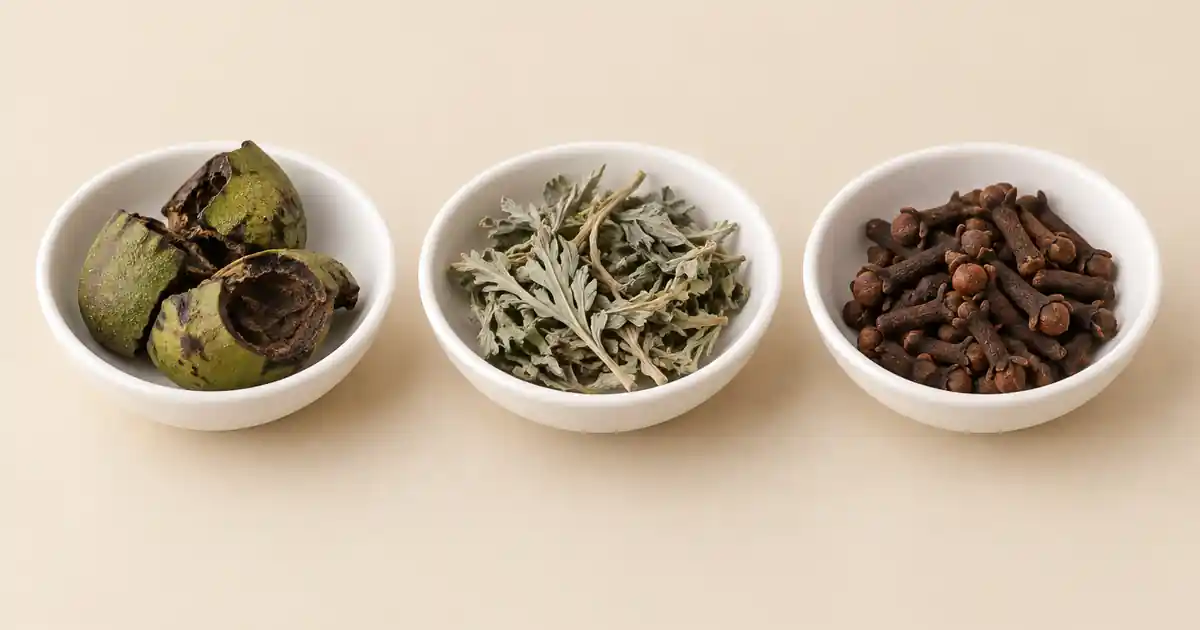
It is a three-botanical blend commonly sold as liquid drops, capsules, or a multi-step herbal program. Modern products often connect it with digestive support or traditional parasite protocols. However, there is no single official recipe, concentration, extraction method, or serving size.
A complete label should identify black walnut hull, wormwood herb, and clove flower bud. These are different plant materials with different chemical profiles.
| Ingredient | Botanical name | Plant part commonly used | Notable constituents | Traditional or product role |
|---|---|---|---|---|
| Black walnut | Juglans nigra | Green outer hull | Juglone, tannins, polyphenols | Bitter and astringent botanical material |
| Wormwood | Artemisia absinthium | Aerial parts or herb | Bitter compounds and variable amounts of thujone | Traditional bitter herb |
| Clove | Syzygium aromaticum | Dried flower bud | Eugenol and other aromatic compounds | Aromatic spice used to balance bitter formulas |
Black walnut is a tree in the Juglandaceae family. Wormwood belongs to the Asteraceae family. Clove comes from a tropical tree in the Myrtaceae family. Their inclusion in one bottle reflects a formulation tradition, not botanical similarity.
What are the traditional uses of this herbal trio?
The combination is mainly associated with bitter digestive preparations and traditional parasite-focused regimens. These uses explain why the ingredients appear together, but they do not establish a confirmed health benefit.
Black walnut hull
Folk herbal practice has used green black walnut hull in strongly astringent preparations. Its tannins create a dry mouthfeel, while juglone has attracted laboratory interest. Most research relevant to microorganisms or parasites involves isolated compounds, test-tube systems, or nonhuman models.
Wormwood herb
Wormwood has a long history as a digestive bitter. European herbal assessments recognize specific traditional uses for defined wormwood preparations, but those assessments do not validate every commercial blend. Wormwood species also matter. Artemisia absinthium is not interchangeable with sweet wormwood, Artemisia annua.
Clove bud
Clove is familiar as a culinary spice. Its aromatic character can make a bitter formula easier to take. Eugenol, a major clove constituent, has shown biological activity in laboratory research. That activity does not establish the performance of a finished three-herb supplement in people.
What benefits are supported by human evidence?
No robust human clinical evidence establishes a specific health benefit for the exact black walnut, wormwood, and clove combination. The evidence is mainly indirect and cannot confirm popular parasite-related claims.
| Evidence type | What it may show | What it cannot establish |
|---|---|---|
| Traditional-use records | How a plant was historically prepared or categorized | That a modern supplement produces a reliable outcome |
| Test-tube studies | Activity against selected organisms under controlled conditions | That normal oral use creates the same exposure in the human body |
| Animal studies | Possible biological mechanisms and safety signals | Human effectiveness or an appropriate consumer serving |
| Studies of one ingredient | Information about a defined botanical preparation | The effect of a three-ingredient commercial formula |
| Human clinical trials | Outcomes for the exact preparation and population studied | Automatic equivalence with differently formulated products |
Laboratory findings are often presented online as proof of broad human benefits. This skips several important questions. Researchers must determine whether the tested compound survives digestion, reaches the relevant tissue, remains active at realistic exposure, and produces a meaningful outcome without unacceptable risk.
The same evidence rule applies when reviewing the HerbEra cleanse formula or another black walnut and clove blend. Claims about a single isolated constituent should not be assigned to the complete tincture unless researchers studied that specific formulation.
Does the combination remove intestinal parasites?
Available evidence does not support using this trio as a substitute for parasite testing and professional care. Different parasites require different diagnostic methods, and similar digestive symptoms can have many unrelated causes.
A laboratory may examine stool, blood, tissue, or other specimens depending on the suspected organism. The Centers for Disease Control and Prevention notes that testing can be difficult and that clinicians may request several stool specimens collected on separate days. There is no single test that detects every parasite.
Self-directed herbal use can delay identification of the actual cause of persistent diarrhea, abdominal discomfort, unexplained weight change, anemia, fever, or symptoms following travel. Seek medical assessment when symptoms persist, become severe, involve blood, or follow possible exposure in a higher-risk region.
What safety concerns matter most?
Safety depends on the species, plant part, extraction method, concentration, serving size, and duration. A culinary amount of clove is not equivalent to concentrated clove oil. Wormwood tea is not equivalent to a high-strength alcohol extract.
Thujone exposure from wormwood
Artemisia absinthium may contain thujone, a neuroactive constituent found in its volatile oil. The amount can vary with the raw material and extraction method. European assessments use preparation-specific restrictions because excessive exposure raises neurological concerns.
A label that lists wormwood without the botanical name, plant part, extract ratio, or thujone specification leaves important questions unanswered. People with a seizure history should seek professional advice before considering a wormwood product.
Clove bud versus clove essential oil
Clove powder, clove extract, and clove essential oil are not interchangeable. Essential oil is far more concentrated in eugenol. Large oral exposures to eugenol oil have caused serious poisoning, including liver injury and neurological symptoms.
Do not use an essential oil as a drop-for-drop substitute for an oral clove tincture. Keep concentrated oils away from children and follow the product’s intended route of use.
Black walnut identity and allergy questions
Products usually use the green outer hull rather than the edible kernel. The label should say “hull” and identify Juglans nigra. People with tree-nut allergies should not assume that a hull extract is allergen-free. They should request product-specific allergen and cross-contact information.
Pregnancy, breastfeeding, children, and medication
Safety data for this three-herb combination are inadequate for pregnancy, breastfeeding, and children. European wormwood assessments do not recommend use during pregnancy or breastfeeding and do not support use in people under 18 without appropriate advice.
Multi-ingredient supplements may also interact with medicines or complicate evaluation of side effects. Ask a qualified clinician or pharmacist before use if you take prescription drugs, use anticoagulant or antiplatelet products, have liver or biliary disease, have a seizure disorder, or are preparing for surgery.
How do tincture and capsule labels differ?
A tincture label should state the botanical ingredients, plant parts, serving volume, and extraction medium. Capsules should distinguish ordinary plant powder from dry extract. Milligrams alone do not reveal concentration.
An alcohol-based tincture may extract a different range of constituents than a glycerin-based product. An alcohol-free claim should describe the finished product clearly. Some products begin with an alcohol extraction and remove most or all of the alcohol later, while others use glycerin or water from the start.
Extract ratios also need context. A 1:5 liquid extract and a 5:1 dry extract use different ratio conventions and should not be compared as if the larger number automatically indicates greater potency.
Proprietary blends make comparison harder because they may disclose only the total blend weight. Prefer a label that gives the amount of each botanical per serving and identifies any carriers, flavors, sweeteners, or processing aids.
Black Walnut, Wormwood, and Clove Product Checklist
Use this checklist before buying herbal cleanse drops or capsules. It focuses on identity, formulation transparency, and basic safety information rather than marketing language.
Confirm all three botanical names
Look for Juglans nigra, Artemisia absinthium, and Syzygium aromaticum. Common names alone can hide species substitutions.
Check each plant part
The expected materials are black walnut hull, wormwood aerial parts or herb, and clove flower bud. Reject vague labels that omit plant parts.
Identify the preparation type
Determine whether each ingredient is a powder, liquid extract, dry extract, or essential oil. These forms are not directly equivalent.
Read the amount per full serving
Check the serving size and daily directions. Do not compare products using the amount per dropper or capsule when serving sizes differ.
Find the extraction medium
For liquid products, look for alcohol, water, glycerin, or another declared medium. Confirm alcohol-free wording on the finished-product label.
Look for wormwood specifications
Check whether the manufacturer addresses thujone content and botanical authentication. “Wormwood” without further detail is not enough.
Review other ingredients
Check for carriers, sweeteners, flavors, preservatives, and undeclared essential oils. These affect suitability and product comparison.
Check testing information
Look for batch identity testing and contaminant screening. A clean label design is not evidence of analytical quality.
Screen for personal risks
Consider allergies, medications, pregnancy, breastfeeding, age, surgery plans, and existing medical conditions before use.
FAQ
What is black walnut, wormwood, and clove traditionally used for?
The trio is associated with bitter digestive preparations and traditional parasite-focused protocols. These uses do not confirm a specific human outcome.
Are black walnut wormwood cloves benefits clinically proven?
No robust human clinical evidence establishes specific benefits for the exact three-ingredient combination.
Is this trio a proven parasite product?
No. Suspected parasitic infections require organism-specific assessment and testing rather than reliance on a general herbal formula.
Which part of black walnut appears in supplements?
Most products use the green outer hull of Juglans nigra, not the edible walnut kernel.
What kind of wormwood should appear on the label?
The traditional bitter herb is usually Artemisia absinthium. It should not be confused with Artemisia annua.
Are clove extract and clove oil the same?
No. Clove essential oil is much more concentrated in eugenol than clove bud powder or many ordinary extracts.
What is thujone?
Thujone is a neuroactive constituent that may occur in wormwood volatile oil. Its concentration varies by material and preparation.
Can children use this herbal combination?
Safety data for the combination are inadequate for children. Wormwood assessments also advise against use in minors without appropriate guidance.
Glossary
Black walnut hull
The green outer covering of the fruit of Juglans nigra.
Wormwood
The bitter herb Artemisia absinthium, which may contain variable amounts of thujone.
Clove bud
The dried unopened flower bud of Syzygium aromaticum.
Juglone
A naturally occurring compound associated with walnut trees and studied mainly in laboratory settings.
Thujone
A constituent of some volatile oils that raises neurological safety concerns at excessive exposure.
Eugenol
The principal aromatic constituent of clove essential oil.
Tincture
A liquid botanical preparation commonly made with alcohol and water or another extraction medium.
Extract ratio
A manufacturing ratio relating starting botanical material to the resulting extract.
In vitro
A study performed outside a living organism, usually in laboratory vessels or cell systems.
Conclusion
Black walnut, wormwood, and clove form a traditional bitter herbal trio, but reliable human evidence for the complete combination remains limited. Evaluate botanical identity, preparation type, thujone information, product testing, and personal safety factors before considering it.
Sources Used
Botanical identity and classification of black walnut, Plants of the World Online — powo.science.kew.org/taxon/Juglans-nigra
Botanical identity and classification of wormwood, Plants of the World Online — powo.science.kew.org/taxon/Artemisia-absinthium
Wormwood preparation and safety assessment, Absinthii Herba — ema.europa.eu/en/medicines/herbal/absinthii-herba
Botanical identity and classification of clove, Plants of the World Online — powo.science.kew.org/taxon/Syzygium-aromaticum
Scientific assessment of thujone exposure, Herbal Medicinal Products Containing Thujone — ema.europa.eu/en/use-herbal-medicinal-products-containing-thujone-scientific-guideline
Clinical overview of concentrated eugenol exposure, Eugenol Clove Oil — ncbi.nlm.nih.gov/books/NBK551727
Overview of parasite testing methods, Diagnosis of Parasitic Diseases — cdc.gov/parasites/testing-diagnosis
Consumer guidance on botanical extracts and standardization, Botanical Dietary Supplements Background Information — ods.od.nih.gov/factsheets/BotanicalBackground-Consumer
Requirements for botanical identity and plant-part labeling, Dietary Supplement Labeling Guide — fda.gov/food/dietary-supplements-guidance-documents-regulatory-information